About
About Par Madja’at
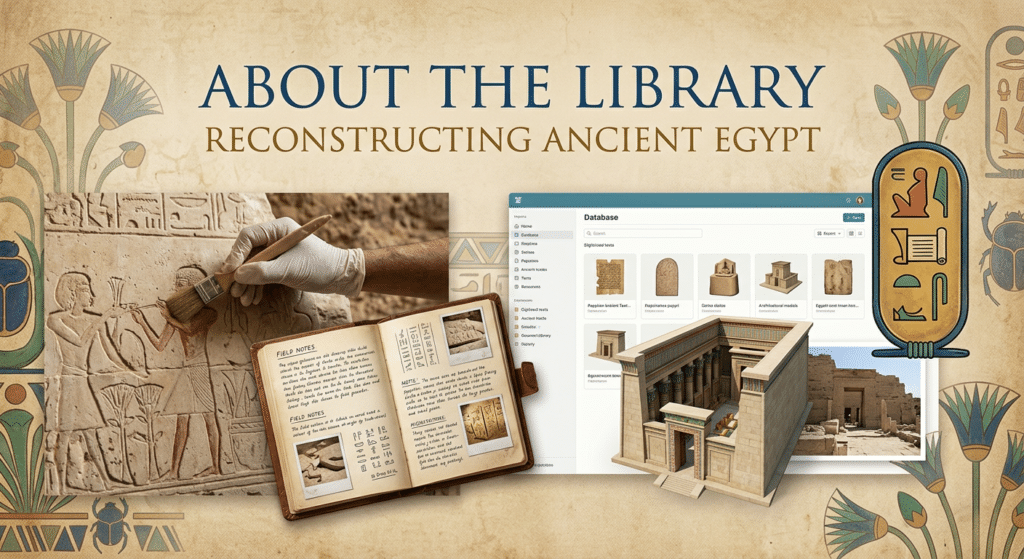
The Par Madja’at (House of Books) is a digital library dedicated to preserving, curating, and delivering high‑quality resources on Ancient Egypt.
Mission
Our mission is to support students, educators, researchers, archaeologists, museum professionals, and institutions with credible, structured, and accessible digital resources grounded in scholarly standards.
We combine peer‑reviewed articles, curated web resources, audio lectures, video seminars, and reference collections into a unified research environment.
What We Provide
Peer‑reviewed original articles with structured abstracts and bibliographies.
Curated web links with credibility scoring and annotations.
Streaming audio: lectures, interviews, guided site walkthroughs.
Video seminars, field reports, object studies, and conference recordings.
Reference collections: glossary, timelines, sites, prosopography.
Research‑grade search, citations, taxonomies, and reading lists
Who We Serve
Editorial Standards
Par Madja’at maintains rigorous editorial and peer‑review practices to ensure scholarly integrity and long‑term reliability.
Reference Collections
Glossary
A curated glossary of ancient Egyptian terms, titles, deities, objects, and concepts. Each entry includes definitions, variant spellings, transliterations, and contextual notes drawn from primary sources and current scholarship.
Timelines
Chronological frameworks covering major periods, dynasties, and transitions in Egyptian history. Timelines include key events, rulers, cultural shifts, and archaeological milestones to support structured historical study.
Sites
A growing catalogue of archaeological sites across Egypt and Nubia. Entries include location data, excavation history, architectural features, associated texts, and references to major publications and field reports.
Prosopography
Biographical profiles of individuals from all periods of Egyptian history. Each entry includes titles, roles, attestations, familial relationships, and references to inscriptions, papyri, and secondary scholarship.
Taxonomies
Structured classification systems that organize texts, objects, genres, rituals, and administrative materials. These taxonomies support advanced research, filtering, and cross‑referencing across the library.
Reading lists
Curated bibliographies for focused study on specific topics, periods, sites, or themes. Each list includes recommended books, articles, primary sources, and digital resources selected for reliability and academic value.
Explore the Library
Discover articles, curated resources, audio, video, and reference collections designed for serious study and lifelong learning.